Self-leveling cement is widely used to create smooth, even surfaces before the installation of flooring materials. Depending on the formulation, calcium aluminate cement can serve as an important hydraulic binder in self-leveling compounds, helping provide rapid setting, early strength, and controlled hardening. Unlike conventional cement-based flooring materials, self-leveling formulations require a careful balance of flowability, setting time, strength, shrinkage, and dimensional stability. Therefore, calcium aluminate cement is often selected as part of a specially designed binder system rather than used alone.
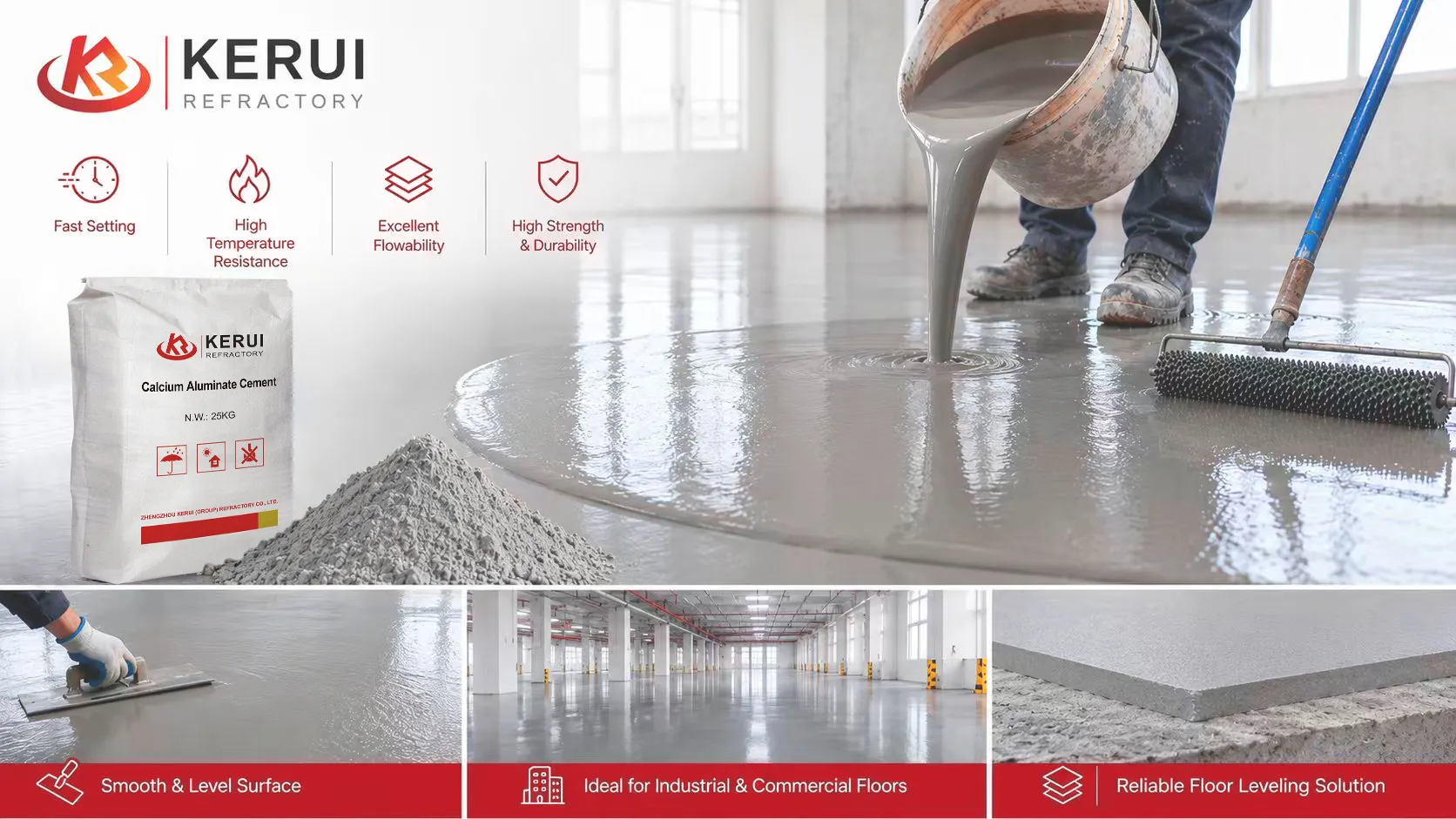
What Is Self-Leveling Cement?
Self-leveling cement, also known as self-leveling compound, self-leveling mortar, or self-leveling underlayment, is a flowable cementitious material designed to produce a relatively smooth and level surface. After mixing with water and other formulation components, the material flows across the substrate and fills minor surface irregularities. As a result, contractors can create a suitable base for materials such as:
- Ceramic tiles
- Vinyl flooring
- PVC flooring
- Wood flooring
- Carpet
- Other resilient floor coverings
The exact formulation varies according to the required setting time, thickness, strength, and application conditions.
Why Use Calcium Aluminate Cement in Self-Leveling Formulations?
Calcium aluminate cement (CAC) differs from ordinary Portland cement in its mineral composition and hydration behavior. This makes it useful for formulations where rapid strength development and controlled setting are important. Depending on the grade and formulation, CAC can contribute to:
Rapid Strength Development
Self-leveling flooring systems often need to reach sufficient strength within a relatively short period. Calcium aluminate cement can contribute to early strength development, helping reduce waiting time before subsequent flooring installation.
Controlled Setting
A self-leveling compound must remain workable long enough for placement and leveling, while still developing strength quickly after application. Therefore, formulators carefully adjust the amount and grade of CAC together with other binders and additives to achieve the required working and setting times.
High Early Performance
CAC can provide high early mechanical performance in properly designed cementitious systems. This characteristic makes it attractive for rapid-repair and fast-track flooring applications.
Compatibility With Specialized Binder Systems
Calcium aluminate cement can work together with other cementitious components and chemical admixtures. For example, some self-leveling systems use combinations of calcium aluminate cement, Portland cement, calcium sulfate, aggregates, and additives to control hydration and final properties. Consequently, CAC should be considered as part of the complete formulation rather than as a standalone self-leveling material.
Common Self-Leveling Applications
Self-leveling cement systems serve a wide range of flooring applications.
Floor Preparation
One of the most common uses is preparing an uneven substrate before installing the final floor covering. The material fills small depressions and creates a more uniform surface. In addition, a properly designed underlayment can improve the appearance and performance of the finished floor.
Renovation Projects
Self-leveling compounds are particularly useful during renovation because they can help correct uneven existing floors without extensive mechanical preparation. Depending on the product, they may be applied over concrete and other suitable substrates after proper surface preparation.
Commercial and Industrial Flooring
Fast-setting self-leveling systems can be useful in commercial buildings, warehouses, factories, and other areas where reducing downtime matters. For these applications, formulators may select CAC-based systems when rapid strength development and specific performance requirements justify its use.
Rapid Repair
Some specialized formulations use calcium aluminate cement to develop strength quickly after installation. These systems can be suitable for repair work where the floor needs to return to service within a limited period.
Typical Components of a Self-Leveling Cement System
Calcium aluminate cement represents only one possible component of a self-leveling formulation. A typical system may contain:
- Calcium aluminate cement – provides hydraulic binding and contributes to early strength
- Portland cement or other binders – adjusts hydration and strength development
- Calcium sulfate – may be used to control setting and phase development
- Fine aggregates – provide volume and dimensional stability
- Polymer modifiers – improve adhesion and flexibility
- Flow agents – improve spreading and leveling
- Defoamers – help control entrapped air
- Retarders or accelerators – adjust working and setting time
The exact formulation depends on the required application and performance targets.
Choosing Calcium Aluminate Cement for Self-Leveling Products
Not every calcium aluminate cement is suitable for every self-leveling formulation. The appropriate grade depends on factors such as:
- Alumina content: Different CAC grades provide different hydration and performance characteristics.
- Setting behavior: The cement must provide enough working time while developing strength at the required rate.
- Compatibility: CAC must work properly with the other binders, aggregates, and chemical admixtures in the formulation.
- Final strength: The formulation should meet the required compressive and flexural strength.
- Application thickness: Thin-layer underlayments and thicker leveling materials can have different formulation requirements.
- Curing conditions: Temperature and moisture conditions can significantly affect cement hydration and final performance.
Therefore, laboratory testing is important before selecting a cement grade for commercial self-leveling products.
Calcium Aluminate Cement Grades from Kerui Refractory
Kerui Refractory supplies different grades of calcium aluminate cement, including CA40, CA50, CA70, and CA80 series. These products provide different alumina contents and performance characteristics, allowing formulators to select a suitable binder according to the intended application. For self-leveling formulations, the appropriate grade should be determined based on the complete formulation rather than alumina content alone. Kerui Refractory can provide technical information to help customers evaluate the suitability of different CAC grades for their formulations.
From Self-Leveling Compound to CAC Selection
The performance of a self-leveling cement depends on the entire formulation, not on one ingredient alone. However, calcium aluminate cement can play an important role when the formulation requires rapid setting, early strength, or specialized hydration characteristics. For this reason, manufacturers of self-leveling cement, self-leveling mortar, floor leveling compounds, and self-leveling underlayments may consider CAC when developing or optimizing their formulations.
Kerui Refractory provides calcium aluminate cement for industrial formulators and construction-material manufacturers, with different grades available for specific formulation requirements.


