Two Main Cement Kiln Types – Refractory Focus
Cement kiln refractory linings face intense heat, abrasion, alkali attack and repeated thermal cycles. This guide covers rotary and vertical kilns, their key zones and suitable brick and castable solutions.
Cement Rotary Kiln
The most widely used kiln system in modern cement production. It consists of the burning zone, transition zone, and cooling zone, operating under extreme temperatures up to 1450°C. Refractories must withstand thermal shock, alkali and sulfur attack, clinker coating formation, and mechanical stress. Common lining materials include magnesia-ferrite brick, magnesia-alumina spinel brick, silica-mullite brick, high-alumina brick, and low-cement castables for critical areas.
Vertical Kiln (Shaft Kiln)
A traditional kiln system still used in small and medium-sized cement plants, lime production, and specialty applications. It contains preheating, calcining, and cooling zones with relatively lower operating temperatures but significant chemical attack, dust erosion, and clinker abrasion. Typical refractory solutions include high-alumina brick, fireclay brick, mullite brick, silicon carbide castables, phosphate-bonded bricks, and abrasion-resistant monolithic linings for long service life.
Cement Kiln Diagrams with Refractory Area Markings
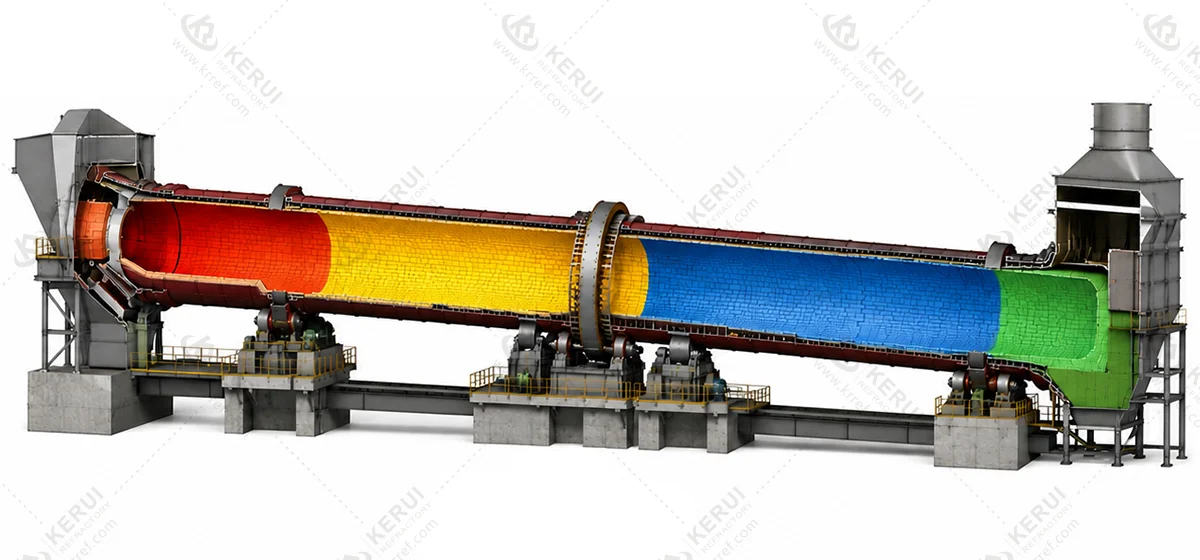
Rotary Kiln – Complete Refractory Zones
From kiln inlet to outlet: burning zone, transition zone, cooling zone and accessories. High-temperature stability and coating compatibility.
Burning zone: MgO-ferrite Brick
Transition zone: Spinel / Mag-Alumina
Cooling zone: High-alumina Brick
Kiln hood: Low-cement Castable
Recommended Refractories for Rotary Kiln
- Burning zone: Magnesia‑ferrite (MgO‑Fe₂O₃) spinel brick – excellent coating retention, chromium‑free.
- Transition zone: Magnesia‑alumina spinel brick or direct‑bonded magnesia brick for thermal cycling resistance.
- Cooling zone / safety zone: High‑alumina brick (≥70% Al₂O₃) or Silica‑mullite brick.
- Kiln hood & outlet: Low‑cement corundum castable with steel fibers, abrasion resistant.
Lining life and downtime depend on kiln design, feed chemistry, operating conditions, installation, and maintenance. Request grade-specific data for your kiln before estimating performance.
Vertical Kiln (Shaft Kiln) – Reliable Lining Solutions
Still widely used in small to medium cement plants, lime kilns and niche applications. Three functional zones: preheating, calcining, cooling.

Preheating zone: Fireclay / High‑Alumina Brick
Calcining zone: Silica-Mullite Brick
Cooling zone: Abrasion‑Resistant Castable
Sidewall lining: Phosphate‑Bonded Brick
Refractory Materials for Vertical Kilns
- Preheating zone (upper shaft): Fireclay brick or low‑creep high‑alumina brick – resists thermal shock.
- Calcining zone (middle shaft): High‑alumina brick (65–75% Al₂O₃) or mullite brick, excellent volume stability.
- Cooling zone (lower shaft): Abrasion‑resistant SiC castable or andalusite‑based brick to withstand clinker abrasion.
- Lining anchors / burner ports: Low‑cement castable and gunning mixes for quick repairs.
Vertical kiln linings must account for alkali exposure, abrasion, and thermal stress. Campaign life varies with kiln design, feed, installation, operation, and maintenance; confirm expected service intervals with technical data.
Refractory Selection Guide by Kiln Zone
| Kiln Type / Zone | Operating Conditions | Recommended Material | Typical Product |
|---|---|---|---|
| Rotary kiln – Burning zone | 1400–1450°C, coating & alkali attack | Magnesia-ferrite brick, Magnesia-alumina spinel | MgO-Fe₂O₃ Spinel Brick |
| Rotary kiln – Transition zone | Thermal cycling, infiltration | Magnesia-alumina spinel, direct bonded magnesia | Mag-Alumina Spinel Brick |
| Rotary kiln – Cooling zone | Thermal shock, abrasion | Silica-mullite brick, High-alumina brick | 70% Al₂O₃ Brick |
| Vertical kiln – Preheating zone | Moderate temp, thermal shock | Fireclay brick, low-creep high-alumina | Low-Creep Fireclay Brick |
| Vertical kiln – Calcining zone | 1100–1300°C, alkali & CO attack | High-alumina brick, mullite brick | Mullite Brick (65% Al₂O₃) |
| Vertical kiln – Cooling zone | Abrasion, clinker impact | SiC castable, andalusite brick | SiC Abrasion Castable |
| Kiln hood / Burner (both) | Thermal radiation, dust | Low-cement castable, corundum castable | Steel-Fiber Castable |
Common Refractory Products for Cement Kilns
Magnesia-Alumina Spinel Brick
Silica-Mullite Brick
High-Alumina Brick (70-80%)
Low-Creep Fireclay Brick
Mullite Brick
SiC Anti-Coating Castable
High-Wear Corundum Castable
Low-Cement Castable
Phosphate-Bonded High-Alumina Brick
Steel-Fiber Reinforced Castable
Insulating Fire Brick
Frequently Asked Questions – Cement Refractories
Which chromium-free brick options are used in rotary-kiln burning zones?
Magnesia-ferrite (MgO-Fe₂O₃) spinel brick is one chromium-free option for rotary-kiln burning zones. Coating behavior and service performance depend on the grade, kiln operation, and feed chemistry; review product data before selection.
How do I select refractories for a vertical cement or lime shaft kiln?
Use a zone-specific lining plan: evaluate fireclay or low-creep high-alumina for preheating, high-alumina or mullite for calcining, and abrasion-resistant SiC castable for cooling. Confirm each grade against temperature, feed, alkali exposure, and wear conditions.
Which refractory may suit a tertiary air duct?
SiC castable or phosphate-bonded high-alumina brick may be evaluated for a tertiary air duct. Select the grade based on dust loading, gas chemistry, temperature, and abrasion; confirm with current technical data.
What practices can help maintain a vertical kiln lining?
Service life depends on grade selection, lining installation, feed characteristics, and operation. Follow the maintenance plan, inspect for wear, and use manufacturer-approved patching or gunning materials. Avoid abrupt process changes where possible.


